Master's degree (2 years)Full timeSustainable Food Systems
The Master’s programme Sustainable Food Systems prepares you to understand, analyse and change food systems. Through interdisciplinary learning and real-world projects, you develop the skills needed to work with food-related challenges in a wide range of sectors.
ECTS credits:
120
Application deadline:
April 15th
International applicants:
December 1st
Start of Studies:
Autumn
Number of students:
45
Requirements:
Applicants must hold a bachelor’s degree (180 ECTS) or equivalent education in a relevant field. Suitable academic backgrounds include agriculture, food science, nutrition, environmental and natural resource management, biology, social sciences, economics, technology or related disciplines. Applicants from other fields may also be considered if they can document relevant competence and strong motivation. Admission is based on academic performance (minimum average grade C / 2.5), documented background and a motivation letter, and interviews may be used when needed. As the programme is taught in English, applicants must meet NMBU’s English language requirements.
Requirements in detail

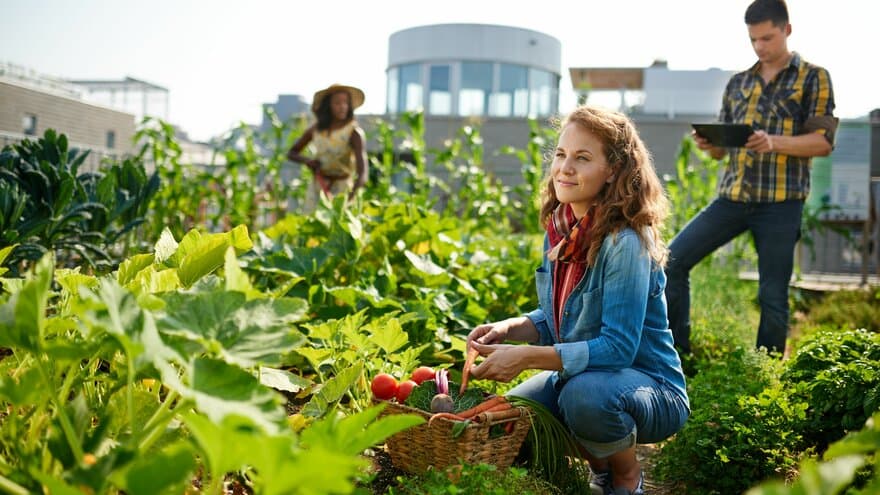


Sustainable Food Systems – education for the present to shape the future of food
Food systems are central to global challenges such as climate change, biodiversity loss, food security, urbanisation and social inequality. Addressing these challenges requires more than technical solutions. They call for professionals with the ability to analyse complex systems, integrate knowledge across disciplines, and translate insights into practical action in collaboration with stakeholders in the field. The Master’s programme Sustainable Food Systems at NMBU equips you with exactly that competence. This two-year, English-taught programme brings together three strong academic traditions – agroecology, urban agriculture and food systems analysis – into one integrated master’s degree with three specializations. You gain a shared foundation in systems thinking and sustainability, while specialising in the area that best matches your interests and career ambitions.
Learn by doing – not just by listening
In this programme at NMBU, sustainability is not just something you only read about – it is something you practice.
The programme is built around action-oriented and experience-based learning, informed by the NMBU Action Education Model. You will work in interdisciplinary teams on real-world cases, often in collaboration with farmers, municipalities, companies, NGOs and international partners. Through projects, fieldwork, reflection and dialogue with stakeholders, you learn how change actually happens in complex food systems.
This approach attracts students from diverse academic backgrounds and creates a dynamic learning environment where different perspectives are valued – whether you come from natural sciences, social sciences, technology or the humanities.
Three specialization – one common purpose
All students start with a shared core that builds competence in systems thinking, transdisciplinary collaboration, and sustainability analysis. From there, you specialise in one of three specializations:
- Agroecological Transformation in Farming and Food Systems
Focus on farming and food systems as socioecological systems, case-based participatory change processes, training of competences and agroecological principles. - Circular Urban Agriculture
Explore urban food systems, circular resource flows and the role of food production in sustainable cities. - Food Systems Analysis and Transformation
Develop advanced skills in analysing food systems across scales, from local value chains to national and global food security.
Each specialization combines theory, methods and hands-on projects, and all culminate in an independent master’s thesis (30, 45 or 60 ECTS), often linked to real societal challenges.
European Master of Agroecology- double degree option in collaboration with ISARA, Lyon, France
The programme has a double degree option which starts with the first semester at NMBU. For the second semester, the double degree students can stay for one more semester at NMBU or they can go on an exchange through ISARAs student exchange agreements. For the third semester double degree student are at ISARA taking classes. And in their final semester they complete a 30 ECTS master thesis.
Please see the website for more information on the double degree programme, structure and application process.
Is this programme for you?
This programme is for you if you:
- care deeply about sustainability, food and societal change
- want to work across disciplines and cultures
- are motivated by real-world problem solving
- seek a master’s degree that combines academic depth with practical relevance
Whether you are coming directly from a bachelor’s degree or returning to university after time in working life, Sustainable Food Systems offers a unique opportunity to develop the knowledge, skills and confidence needed to help shape the future of food.
Career opportunities
An international programme – rooted in real-world challenges
The programme is taught in English and attracts students from Norway and around the world. You can spend a semester abroad through NMBU’s extensive exchange agreements or choose an internship to strengthen your link to working life or research.
Graduates go on to careers in:
- advisory services and development initiatives
- education, research and PhD studies
- entrepreneurship and innovation
- environmental conservation
- food and sustainability-related businesses
- international organisations and NGOs
- policy development and public administration
Program structure
Exchange possibilities
More about the program
Study advisor(s):

Gisken Trøan

Societal relevance
Food production and food systems are closely linked to some of the world's biggest challenges: climate change, biodiversity loss, social inequality, urbanization and food security. Understanding and solving these challenges requires interdisciplinary expertise and the ability to analyze complex systems. This study program directly addresses these problems and educates people who can contribute knowledge and solutions where the need is greatest.
Future food systems must be more sustainable – environmentally, socially and economically. The master programme combines agroecology, urban agriculture and food system analysis to give students a holistic perspective on how food can be produced with less strain and greater justice.
Traditional theory is not enough to solve “wicked problems” in food systems. The program is based on NMBU's action- and experience-based learning model, where students work on real cases in collaboration with farmers, municipalities, businesses and NGOs. This gives students skills that are in demand in the working world: collaboration, problem solving, critical thinking and the ability to translate theory into practice.
Because food-related challenges are complex, we need people with backgrounds in natural sciences, social sciences, technology, economics, and humanities working together. The program attracts students from many disciplines, thereby reflecting real-world work processes in society and business.