
1241 000 EURO BIOECONMY IN THE NORTH (BIN)

About the project
Objectives
Main objective: ForestFeed aims to strengthen the bioeconomy in the northern region through cross-sectoral collaboration. The project focuses on biorefining forest biomass into valuable protein sources, with the goal of increasing value creation and sustainability in both the forestry and aquaculture sectors.
Sub-objectives:
- Develop a scalable bioprocess for the efficient conversion of forest biomass side streams into microbial ingredients (MI, Paecilomyces variotii, Pekilo) as an alternative feed resources for aquaculture.
- Fractionate bioactive components from Pekilo for use in functional aquafeeds.
- Evaluate the nutritional value and functional effects of Pekilo and its bioactive components in feeds for salmonids exposed to multiple stressors.
- Investigate growth and health effects of Pekilo in large-scale salmon feeding trials in collaboration with BioMar.
- Assess the environmental footprint, economic feasibility, and market opportunities of the new forest-based innovation.
- Establish a new Nordic, interdisciplinary consortium for innovative, cross-sectoral research.
- Facilitate innovation and future commercial success based on forest biorefining in the Nordic region.
Background
Forest biomass is a significant yet underutilized resource in the Nordic region with high potential for value creation. To unlock this value, it is crucial to ensure a targeted and holistic use of forest raw materials. The growing need to extract more value from forest resources is driving efforts to strengthen the bioeconomy of the forestry sector.
ForestFeed leverages bioprocessing of forest-based feedstocks—particularly side streams—as inputs for producing high-value protein sources for aquaculture. The project focuses on Pekilo, a microbial ingredient (MI) produced from a selected strain of the filamentous fungus Paecilomyces variotii.
The global demand for protein is rising, and production from both livestock and aquaculture is expected to grow significantly in the coming years. Aquaculture, in particular, is poised to play an increasingly vital role in sustainable food production. In Norway, salmon production is projected to grow by 20% by 2030. However, this growth is constrained by the limited availability of sustainable feed ingredients, making the country heavily reliant on imports. There is an urgent need to develop local, low-footprint feed ingredients based on non-food-competing resources. Microbial ingredients are a promising solution in this regard.
At the same time, the aquaculture industry is facing major challenges related to disease and high mortality rates due to complex stress factors. In 2023, over 60 million farmed fish died in Norway, with the highest mortality occurring during the juvenile (smolt) phase. The main causes were de-licing injuries, gill diseases, and winter ulcers. Future feed solutions must therefore not only support high growth performance, but also promote fish health and resilience.
There is growing interest in microbial feed ingredients, as they are highly nutritious and contain bioactive compounds that can enhance fish health and welfare.
ForestFeed addresses these needs through an interdisciplinary, cross-sectoral collaboration aimed at upcycling forest biomass into valuable nutrients and health-promoting products. With a circular bioeconomy approach, the project will strengthen both the forestry and aquaculture sectors and lay the foundation for innovation and future commercial success in forest biorefining in the Nordic region.
Relevance for the Bioeconomy in the North
The ForestFeed project is highly relevant for the development of the bioeconomy in the North. It will:
- Convert underutilized biomass and forest industry side streams into high-quality feed resources and bioactive compounds for aquaculture. This will enable the creation of a new forest-based value chain in northern regions and connect the blue (aquaculture) and green (forestry) sectors. The outcome is increased self-sufficiency and reduced climate footprint through sustainable, locally produced feed ingredients for aquaculture.
- Secure access to sustainable and health-promoting feed resources that support optimal growth and improved fish health and welfare.
- Develop valuable products from renewable forest biomass, reduce emissions through circular processes, and ensure full utilization of wood-based raw materials.
- Establish a strong, interdisciplinary research and innovation network with partners from Norway, Finland, Sweden, Germany, and Canada—with the overarching goal of advancing a forest-based bioeconomy and contributing to climate change mitigation in the Nordic region.
The research
ForestFeed project is a spin-off project to Foods of Norway, a Centre for research-based Innovation, where we have developed microbial ingredients (e.g. yeast and filamentous fungi) from spruce tree sugars and isolate bioactive components from brown seaweed (e.g fucoidan and laminarin) for use in functional feeds to promote fish health and robustness. ForestFeed is also linked to the NordicFeed project where we work across the Nordic region to develop microbial ingredients from a range of side streams, including underutilized forest biomass and food waste for novel salmon and rainbow feed.
WP structure and workflow
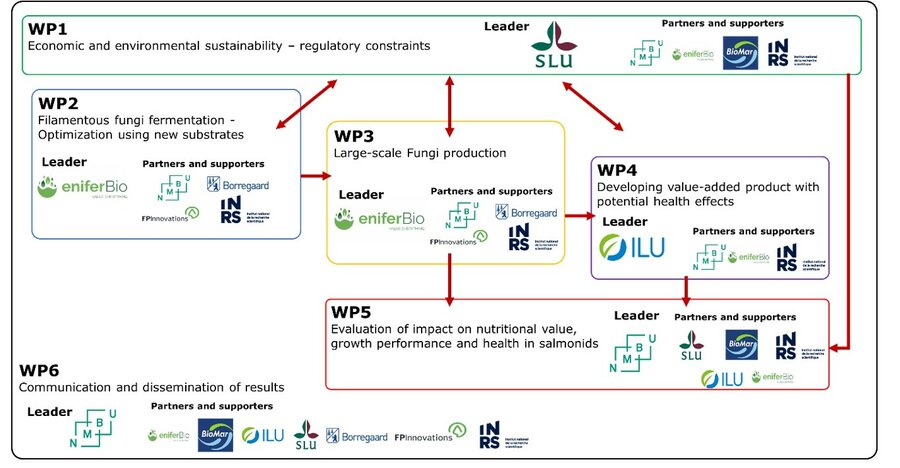
Figure ForestFeed Photo: ForestFeed ForestFeed will upcycle forestry waste streams through bioconversion to PEKILO® as a protein source and will thereby address emerging demand for sustainable aquafeeds. Risk of using such forestry waste streams to produce PEKILO® and techno-economic analysis of PEKILO® process for an industrial scale plant will be done. Environmental life cycle assessment (E-LCA) and a life cycle cost (LCC) assessment of the optimized aquaculture system will also be performed.
Results
A New feed may promote healthier salmon
PEKILO® is a novel microbial protein produced from forestry by-products, offering a sustainable and functional ingredient for aquafeeds. Studies with Atlantic salmon show that diets containing PEKILO® support normal growth, maintain good health, and stimulate the general immune system. In feeding experiment wiith Atlantic salmon, diets including PEKILO®, alone or in combination with microalgae oil (Schizochytrium sp.), supported normal growth, efficient feed utilization, and good overall fish health.
Fish fed diets containing PEKILO® also showed signs of general immune stimulation, indicating its potential as a functional feed ingredient. When tested under challenge conditions with Moritella viscosa, the bacterium associated with winter ulcers, fish receiving moderate levels of PEKILO® combined with microalgae oil demonstrated a tendency toward improved survival and reduced disease incidence.
These findings highlight PEKILO® as a promising, sustainable ingredient that can help maintain performance while supporting fish robustness in aquaculture. Further studies under commercial farming conditions will continue to explore its full potential.
Field Experiment
PEKILO® is a novel, sustainable protein produced from forestry side streams, offering functional benefits for salmon aquaculture. In a field experiment with Atlantic salmon, diets containing PEKILO® performed well compared to a standard commercial feeds, supporting normal growth, feed intake, and overall fish health. In addition to providing high-quality nutrition, PEKILO® contains bioactive components that may strengthen gut integrity, support immune function, and improve resilience to environmental and handling stress. These results highlight its potential as a scalable and sustainable ingredient for future aquafeeds.
.
Publications
- Hooft, J. M., Tran, H. Q., Montero, R., Morales-Lange, B., Stejskal, V., Mydland, L. T., & Øverland, M. (2024). Environmental impacts of the filamentous fungi Paecilomyces variotii (PEKILO®) as a novel protein source in feeds for Atlantic salmon (Salmo salar). Aquaculture, 596, 741779. https://doi.org/10.1016/j.aquaculture.2024.741779
- Mensah, D. D., Montero, R. T., Morales-Lange, B., Øverland, M., & Mydland, L. T. (2024). In vitro salmonid models as tools for studying microbial-derived immunostimulants and aquaculture relevant salmonid pathogens: Current status and future perspectives. Aquaculture, 595, 741695.
- Mensah, D. D., Morales-Lange, B., Øverland, M., Baruah, K., & Mydland, L. T. (2024). Differential expression of immune-related biomarkers in primary cultures from Atlantic salmon (Salmo salar) exposed to processed Paecilomyces variotii with or without inactivated Moritella viscosa. Fish & Shellfish Immunology, 148, 109506. https://doi.org/10.1016/j.fsi.2024.109506
- Mensah, D. D., Morales-Lange, B. M., Rocha, S., Øverland, M., Kathiresan, P., Hooft, J. M., Press, C. McL., Sørum, H., & Mydland, L. T. (2025). Paecilomyces variotii improves growth performance and modulates immunological biomarkers and gut microbiota in vaccinated Atlantic salmon pre-smolts. Fish & Shellfish Immunology, 160, 110223.
- Mensah, D. D., Morales-Lange, B. M., Neteland, M., Røsvik, M., Øverland, M., Press, C. McL., Sørum, H., & Mydland, L. T. (2025). Bioactive properties of filamentous fungus Paecilomyces variotii KCL 24: New insights into modulation of Atlantic salmon health and welfare after seawater transfer. Food Bioscience, 107053.
- Gaudhaman, A., Karimi, S., Lundh, T., Øverland, M., Taherzadeh, M. J., Langeland, M., Baruah, K., & Vidakovic, A. (2025). Fungal Protein from Non-Food Bioresources in Diets for Rainbow Trout (Oncorhynchus mykiss). Fishes, 10(4), 149. DOI: 10.3390/fishes10040149.
Gaudhaman A, Vidakovic A, Warwas N, Doyle D, Morales-Lange B, Øverland M, Lundh T, Baruah K. 2026. Paecilomyces variotii mycoprotein in diets for juvenile rainbow trout: effects on growth performance, intestinal health, and technical feed quality. In press Aquaculture Nutrition
Scientific meetings
ISFNF 2024
Margareth Øverland, Ruth T. Montero, Byron Morales-Lange, Jamie Hooft, Ruth Sergio D. C. Rocha, Brankica Djordjevic, Liv Torunn Mydland
NOVEL MICROBIAL PROTEIN SOURCES PRODUCED FROM FOREST SIDE STREAMS SUPPORT HIGH GROWTH PERFORMANCE, HEALTH AND PRODUCT QUALITY OF ATLANTIC SALMON
ISFNF, May, 2024, Puerto Vallarta, MexicoHooft J.M., Montero R., Morales-Lange B., Blihovde V.F1, Purushothaman K., Press C.M., Mensah D.D., Mydland L.T. and Øverland M.
Paecilomyces Variotii in novel feeds for Atlantic salmon: Effects on pellet quality, growth performance, gut health, and nutrient digestibility and utilization
ISFNF, May, 2024, Puerto Vallarta, MexicoMensah1*, Dominic, B. Morales-Lange1, M. Øverland1, K. Purushothaman2, C.M. Press2, L. T. Mydland1
BEYOND NUTRITIONAL VALUE: MYCOPROTEIN PAECILOMYCES VARIOTII IMPROVES GROWTH PERFORMANCE AND OVERALL, HEALTH RESPONSES IN ATLANTIC SALMON (Salmo salar)
ISFNF, May, 2024, Puerto Vallarta, MexicoEAS 2023
Hooft, Jamie M. Hooft, Byron Morales-Lange, Ruth Montero, Dominic D. Mensah, Veronica F. Blihovde, Sana Javed, Heikki Keskitalo, Liv T. Mydland, and Margareth Øverland
Paecilomyces variotii in novel feeds for Atlantic salmon: Effects on pellet quality, growth performance, nutrient digestibility and utilization, and immune-related biomarkers in the distal intestine. Aquaculture Europe, September 18-21, 2023, Vienna, Austria.Mensah, Dominic D. Mensah, Byron Morales-Lange, Margareth Øverland, Kartik Baruah, Liv Torunn Mydland
Beyond nutritional value: Mycoprotein Paecilomyces variotii improves growth performance and overall health responses in Atlantic salmon. Dominic D. Mensah, Byron Morales-Lange, Margareth Øverland, Kartik Baruah, Liv Torunn Mydland Aquaculture Europe, September 18-21, 2023, Vienna, Austria.Øverland, Margareth, Byron Morales-Lange, Jamie Hooft, Ruth T. Montero, Sergio D. C. Rocha, Dominic D. Mensah, Brankica Djordjevic, Liv Torunn Mydland
Solving the raw material crisis: A Norwegian perspective on developing functional ingredients for novel aquafeeds.Aquaculture Europe, September 18-21, 2023, Vienna, Austria.EAS 2025
Røsvik, M., Morales-Lange, B., Rocha, S., Øverland, M., Mensah, D. D., Sørum, H., Mydland, L. T., Blihovde, V., & Quintanilla, C. G. Growth performance and robustness of Atlantic salmon Salmon salar fed diets containing varying combinations of two different microbial ingredients Paecilomyces variotii and schizochytrium sp. Aquaculture Europe Society meeting, September 24, 2025, Valencia, Spain.Other scientific meetings, 2024
Øverland, Margareth.
Kan vi få fart i fornybar fôrproduksjon fra bærekraftige mykoproteiner? Ernæringssemninaret, Bergen, 11, mars, 2024.Mensah, Dominic D., Byron Morales-Lange, Sergio D.C. Rocha, Margareth Øverland, Liv-Torunn Mydland. 2024
Paecilomyces Variotii Improves Growth Performance, Modulates Immune-Related Biomarkers and Gut Microbiota in Freshwater. The 8th annual conference of Digital Life Norway Research School, 14-16 October 2024, Hurdalsjøen Hotell & Spa, Hurdal NorwayPopular science communication
Øverland, Margareth.
Invited speaker:- 2024. Solving the raw material challenge: A Norwegian perspective on developing circular proteins for novel feeds. The European Society of Veterinary and Comparative Nutrition (ESVCN) Congress 11 - 13 September 2024, Belfast, Ireland
- 2024. Upcycling underutilized forestry biomass into high-value microbial protein sources for aquafeeds 2nd International Cellular Agriculture Conference, June 11th to June 13th, Aarhus, Denmark.
- 2024. Managing the Feed/Food divide. Pre-symposium organized by IFFO. International Symposium on Fish Nutrition and Feeding 2024. (ISFNF, XXI), Puerto Varas, Mexico, 23 May, 2024.
Key Personnel
Norwegian University of Life Sciences (NMBU), Faculty of Biosciences
Swedish University of Agricultural Sciences (SLU)
- Prof. Ivar Vågsholm, Department of Animal Biosciences
- Dr. Elin Röös, Department of Energy and Technology
- Dr. Ingrid Strid, Department of Energy and Technology
- Dr. Louise Bartek, Department of Energy and Technology
- Dr. Kartik Baruah, Department of Animal Nutrition and Management
Institute for Food and Environmental Research e.V. (ILU)
- Dr. Kathleen Zocher
- Ms. Mihaela Bogdanova
Industry Partners:
- Mr. Heikki Keskitalo, Enifer, Finland
- Mr. Joosu Kuivanen, Enifer, Finland
- Dr. Vegard Denstadli, BioMar, Norway
- Ms. Maja Erichsen, BioMar, Norway
Associated Partner:
- Borregaard