
Can grazing animals wearing a digital collar learn to associate the signals from the collar with an invisible boundary and connect that information to their own behavior?
The use of virtual fencing is steadily increasing in Norway and is likely to represent the future of livestock fencing.
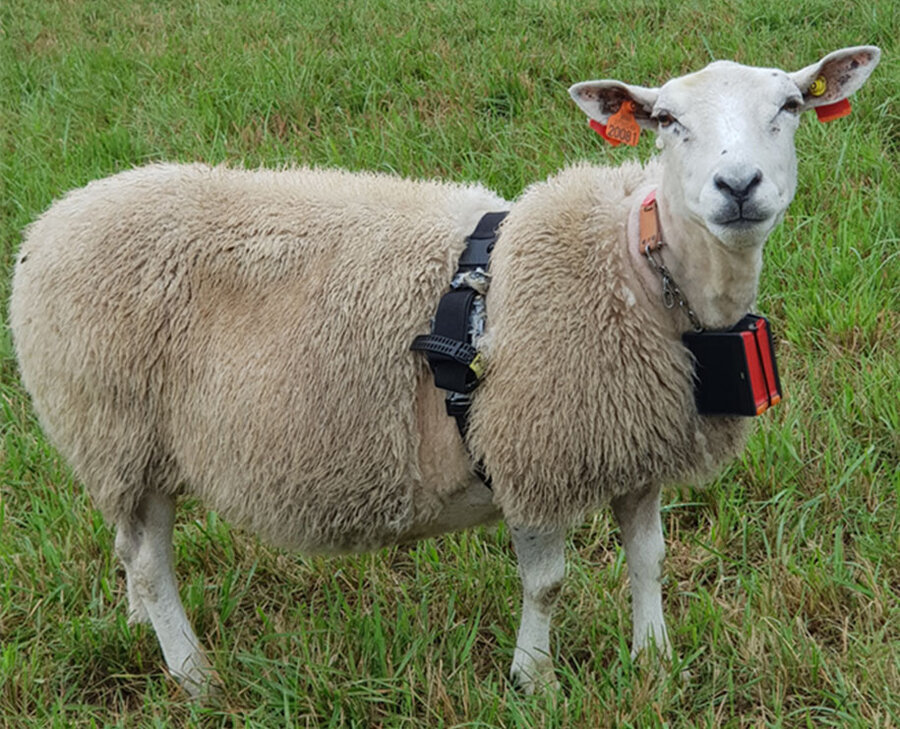
A virtual fence consists of a solar-powered collar attached around the animal's neck. GPS technology in the collar communicates with an application on the farmer's mobile phone via the cellular network. The fence boundary is defined within the app, determining where the virtual fence is placed across the landscape.
Sound Warning or Electric Pulse
The system's purpose is to keep animals within the virtual boundary. When an animal approaches the fence line, the collar emits an audio warning signal, indicating that the animal has reached the boundary and should turn around.
If the animal ignores the warning and continues forward, it receives a mild but effective electric pulse. The system is suitable for sheep, goats, and cattle.
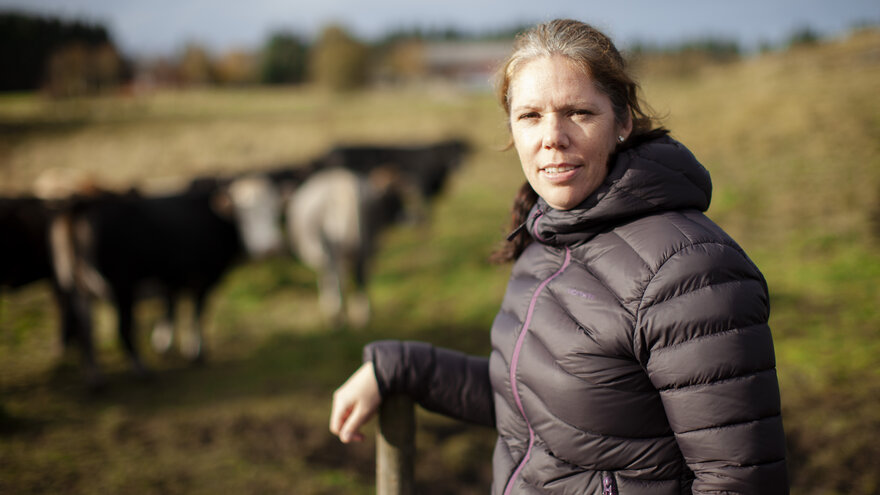
Silje Eftang at the Norwegian University of Life Sciences (NMBU) investigated how virtual fencing affects animal behavior, stress responses, and learning ability.
A Natural Response to the Audio Warning
But how do the animals know what to do when they hear the sound and perhaps receive an electric pulse? They do not initially know where the warning comes from or what it means.
Or do they?
This was one of the questions Eftang wanted to explore.
Her studies showed that after only a couple of days, animals learned to turn around when they heard the audio signal, allowing them to stay within the grazing area.
"We found that turning around was a natural response. The animal at the front that receives the warning sound and the pulse will turn around and return to the flock," says Eftang.
Associating a sound signal with an electric pulse is a natural learning process for animals. According to Eftang, the results provide an excellent demonstration of well-established learning theories.
"We know that animals are capable of linking these events to their own behavior. In other words, through their actions they can avoid or obtain certain outcomes."
Individual Differences in Behavior
"We observed considerable variation among animals in how many audio warnings they received. Some rarely interacted with the sound boundary, while others consistently grazed with their noses in the warning zone. These animals heard many warnings but received relatively few pulses compared to the number of audio signals they encountered," says Eftang.
The warning sound consists of a series of tones with increasing frequency. The closer the animal gets to the pulse zone, the higher the pitch becomes. When the animal turns around, the pitch decreases until the sound stops altogether.
Eftang explains that animals frequently entering the sound zone appeared to know exactly which tone preceded the electric pulse. Other animals, less willing to challenge the warning, turned around as soon as they heard the sound.
"It was clear that personality influenced whether animals were willing to take the risk of grazing in the warning zone or preferred to avoid it altogether."
How Quickly Do Animals Learn to Avoid the Pulse?
In addition to recording how often animals experienced warning sounds and electric pulses, Eftang also observed their behavior.
After only a few days, the animals became increasingly successful at avoiding pulses.
This demonstrated that they had learned to associate the warning sound with the pulse and began turning around as soon as they heard the signal.
By days four and five, newly introduced animals were just as skilled at avoiding pulses as animals already experienced with virtual fencing.
"Animals also learn from each other. Farmers using the system report that they only need to train a flock once. New animals quickly learn when they are integrated into a flock containing many experienced animals."
Testing Two Learning Methods
During the training experiments, some animals initially ran straight ahead instead of turning around.
Eftang therefore tested two different approaches for teaching animals to respond to the warning sound.
The first was a controlled approach to the boundary, where Eftang and assistants stood outside the virtual fence.
"We attracted the animals with concentrate feed, and when the leading animal heard the warning sound and received a pulse, we prevented it from running forward by waving our arms. The animal then turned around and returned to the grazing area."
The second method allowed animals to learn through their own experience.
When an animal approached the boundary, received the warning and the pulse, while the rest of the flock continued grazing calmly inside the boundary, the animal would typically turn around and rejoin the others.
"The results showed no difference between the two approaches," says Eftang.
This is useful knowledge for farmers training their livestock.
Animals Quickly Notice When the Boundary Moves
In addition to Eftang's research, several large pilot projects have been conducted on commercial farms as part of the technology approval process.
Today, virtual fencing technology is approved for use in Norway with sheep, goats, and cattle.
One major advantage of virtual fencing is its flexibility. Farmers can easily expand grazing areas by adjusting the boundaries in the app.
When a virtual pasture is enlarged, the animals that spend more time near the sound boundary are often the first to discover the change and lead the way into new areas. Alternatively, other animals may accidentally enter the newly available area after the boundary has been moved.
Animals quickly realize that the warning sound no longer occurs where they previously expected it and that moving toward fresh grass gives them access to new grazing land.
"They move into the expanded area very quickly. We observed that within 15 minutes, all animals had moved onto the new pasture," says Eftang.
Long-Term Life Within Virtual Fences
According to Eftang, it is important to emphasize that it is the sound signal that tells animals where they may and may not go. When the sound is absent, animals should feel safe moving through areas where warnings had previously occurred.
The goal is not for animals to develop an aversion to a particular physical location.
"There will probably be differences between animals grazing long-term on the same pasture, where they expect sounds at specific locations, and animals grazing in areas where boundaries are moved more frequently."
Compared with traditional electric fencing, animals on virtual pastures rely on hearing rather than sight. Animals react to the electric pulse delivered by the virtual fence, just as they react to a pulse from a conventional electric fence.
"As long as animals can recognize the signals and turn around in response to the warning sound, the system is both predictable and controllable from the animals' perspective. In that case, it is no more stressful than being behind a conventional electric fence. I do not think it is any more controversial than a standard electric fence," says Eftang.
Animal Welfare Benefits of Virtual Fencing
Virtual fencing offers several advantages compared with physical fences.
Neither livestock nor wild animals can become trapped in the fence. It is also possible to fence off hazardous areas within a pasture, such as tunnel entrances, steep slopes, and roads.
The system is particularly useful in areas where physical fencing is difficult, for example where there are large amounts of rock, mountains, or natural barriers.
Using larger grazing areas and regularly moving pasture boundaries can also reduce parasite pressure, potentially leading to reduced use of medication.
Another benefit is improved animal monitoring. All animals within a grazing area can be viewed on a map through the system's application. The system sends alerts if an animal stops moving or shows unusual activity patterns.
"This could of course be achieved through ordinary GPS tracking, but here tracking and fencing are combined in a single solution," says Eftang.
She believes that the technology provides greater control over grazing animals and enables individual monitoring, creating significant benefits for animal welfare.
Referanser:
Silje Eftang: Beitedyr i en virtuell verden: Læring, atferd og velferd ved introduksjon til et virtuelt gjerdesystem (PDF). Doktoravhandling ved NMBU, 21. mars 2025.
Silje Eftang mfl.: Goats are able to adapt to virtual fencing; A field study in commercial goat herds on Norwegian farms. Applied Animal Behaviour Science, 2022. Doi.org/10.1016/j.applanim.2022.105755
Silje Eftang mfl.: Sheep’s learning ability and behavioural response to a fully automated virtual fencing system. Applied Animal Behaviour Science, 2023. Doi.org/10.1016/j.applanim.2023.106112